
Tagging the Last Giants: FIVE Pangolins, One Turning Point
Why Tagging Matters
Fewer than 30 Giant Ground Pangolins are believed to remain in the Nyekweri ecosystem.
Over the past several years, conservation efforts have focused on securing habitat - protecting land, de-electrifying fences and working closely with local communities.
But pangolins do not recognise conservation boundaries. They move across forests, farms and river corridors, sometimes entering areas where electric fencing poses a serious risk.
To protect them, we first need to understand where they move and when they are in danger.
Every Pangolin Counts
In partnership with Kenya Wildlife Service, The Pangolin Project has launched a new phase of work:
Every. Pangolin. Counts.
The aim is to tag and monitor every remaining Giant Ground Pangolin in Nyekweri.
Using telemetry transmitters, rangers can now monitor individuals nightly, track movement patterns and build risk maps across the landscape - helping teams respond when pangolins move toward high-risk areas such as electric fences.
What follows is the evolving story of this work in the field.
“This marks a change in our work from securing space to active species-level safeguarding.” Dr Claire Okell - CEO The Pangolin Project
The Work - Five Pangolins Tagged
In the first weeks of the programme, patience, teamwork and community collaboration quickly began to pay off.
“The first pangolin tagged during this period was found on Tuesday, 3 February, a day the team half-jokingly refers to as their “lucky day” due to repeated successes in the field”
“The combination of tagging, telemetry and EarthRanger is allowing us to monitor individuals and build a real picture of risk across the landscape.”

Our 5th tagged Giant Ground Pangolin
“GP012 seem to be good for locating other females for us. After we have retagged him one night, we later discovered that there was a second pangolin coming out of his burrow.”
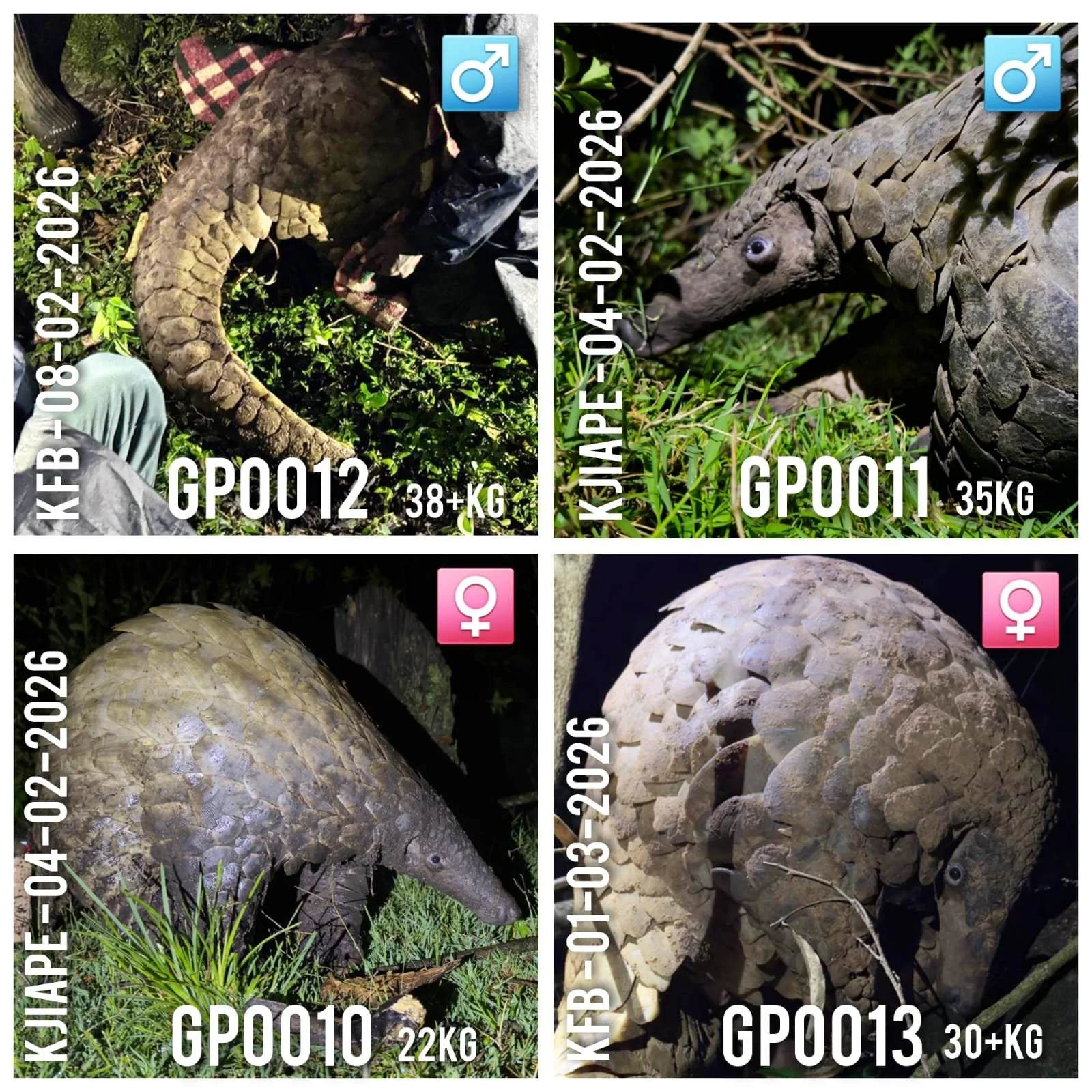
Pangolin 0010 – The Sub-Adult Female
The first individual was found after a local community member reported seeing a pangolin near the forest edge late at night.
The team responded immediately. By 1am they had reached the animal - a calm sub-adult female weighing 22 kilograms.
She was tagged successfully and released. The following morning camera traps were installed near her burrow to begin monitoring her movements.
The moment highlighted something critical: Community members are now active partners in pangolin protection.
Pangolin 0011- The Surprise Male
Just a night after tagging the first pangolin, the team returned to the field for a routine telemetry check. Pangolin 0010 was active and foraging normally, and just after midnight she moved back toward her burrow. The team began driving back toward camp.
Then something unexpected happened.
“While driving away, we noticed a light approaching in the distance. It turned out to be the same community member from the previous night, urgently reporting another pangolin. With no mobile network in the area, the community members had run when they heard our car.” - Koen Betjes
Within minutes the team arrived at the location. Just a short walk into the forest revealed a large adult male Giant Ground Pangolin. Fortunately, the tagging equipment and transmitters were still in the vehicle.
The animal remained remarkably calm as the team worked, allowing them time to observe him closely before fitting the transmitter. The tagging was completed in under ten minutes. Two pangolins had now been successfully tagged in less than 48 hours.
Another reminder that protecting pangolins is never just about technology - it is about community, preparedness, and being ready when the moment comes.
Pangolin 0012 - Patience and Rain
The third individual required several days of monitoring.
Camera traps showed repeated use of a burrow, but heavy rain changed the pangolin’s emergence time. Using this information, the team returned before sunset and positioned themselves quietly in the forest using thermal scopes to avoid disturbance.
After a long wait, a pouched rat emerged first. Then at 7:50 pm, the pangolin finally appeared. When the animal moved far enough from the burrow, the tagging team stepped in. This adult male was extremely strong and resistant, but the experienced team completed the tagging in just over ten minutes.
Based on visual assessment, he may weigh more than 40 kilograms - one of the largest individuals the team has encountered!
Pangolin 0013 - Rediscovered by the River
The fourth tagging came after weeks of searching. One tagged male had briefly disappeared from telemetry tracking. Camera traps eventually revealed activity near the Metete River.
During a night patrol through the forest, the team spotted movement through a thermal scope.An untagged pangolin.
The animal believed to be a female was carefully held while the tagging team arrived. She was fitted with a VHF transmitter and monitored until she safely returned to her burrow. Moments later the team detected the signal of the previously tagged male nearby.
For the first time, two tagged pangolins were confirmed active in the same riverine habitat.
Pangolin 0014 – The One We Weren’t Looking For
The fifth tagging began as a routine monitoring patrol. After retagging GP012, the team noticed another pangolin emerging from the same burrow shortly after they had left. When GP012 later settled in a different burrow, Koen headed out one rainy evening with a thermal scope, hoping to observe him from a distance.
Instead, the team found something completely unexpected. Just 30 metres into the forest, a giant pangolin appeared in the thermal scope only four metres away. At first, they assumed it was GP012, but there were no drill holes and no transmitter. This was an entirely untagged animal.
The team held position in the pouring rain while additional support and tagging equipment arrived. The operation was completed successfully, making GP014 the fifth Giant Ground Pangolin tagged under the programme. Initially thought to be male, later observations suggest GP014 may in fact be female - another reminder that even with careful monitoring, the forest still has surprises to reveal.
Evidence of Progress
In just a few weeks:
5 Giant Ground Pangolins tagged
Multiple individuals now monitored nightly
Camera traps deployed across high-use areas
Patrol teams tracking movements using thermal scopes and telemetry
Electric fence locations mapped to identify high-risk zones
This growing data is now being integrated into EarthRanger, allowing the team to build real-time risk maps across the landscape.
For the first time, pangolin movements can be monitored alongside mapped fence lines. When an individual approaches a high-risk area, geofencing alerts can trigger patrol responses, allowing rangers to intervene before an incident occurs.
Tagging is not a permanent solution. It is a temporary safeguard while habitat protection continues to expand.
But it gives the team something they have never had before: visibility.
And with visibility comes the ability to act.
Beyond risk mitigation, tagging is already revealing behaviours we have rarely been able to observe before. By following individuals over time, the team is beginning to understand how Giant Ground Pangolins move through the landscape - where they forage, how they use burrows, and how their activity changes with rainfall and habitat conditions.
Camera traps and telemetry have already captured multiple individuals using the same burrow systems, suggesting a level of burrow sharing or sequential use that has rarely been documented in this species. Early tracking data also shows that home ranges can vary widely, from around 7.5 km² to as much as 50 km², depending on the age and behaviour of the animal. These insights are helping the team build a clearer picture of how pangolins use the Nyekweri ecosystem - knowledge that will be critical for designing safer conservation areas and movement corridors in the future.
What Comes Next
The work is only just beginning.
Over the coming months, the team will continue to:
Tag additional individuals
Strengthen telemetry monitoring across the forest
Expand EarthRanger risk mapping and geofencing alerts
Map electric fence density across the wider landscape
Expand conservation leases and restore habitat connectivity
Build safer ecological corridors for wildlife movement
Each tagged pangolin helps reveal how these elusive animals move through the forest, rivers and farms of Nyekweri.
And each new insight brings us closer to ensuring the last Giant Ground Pangolins in Kenya survive long enough to recover.
